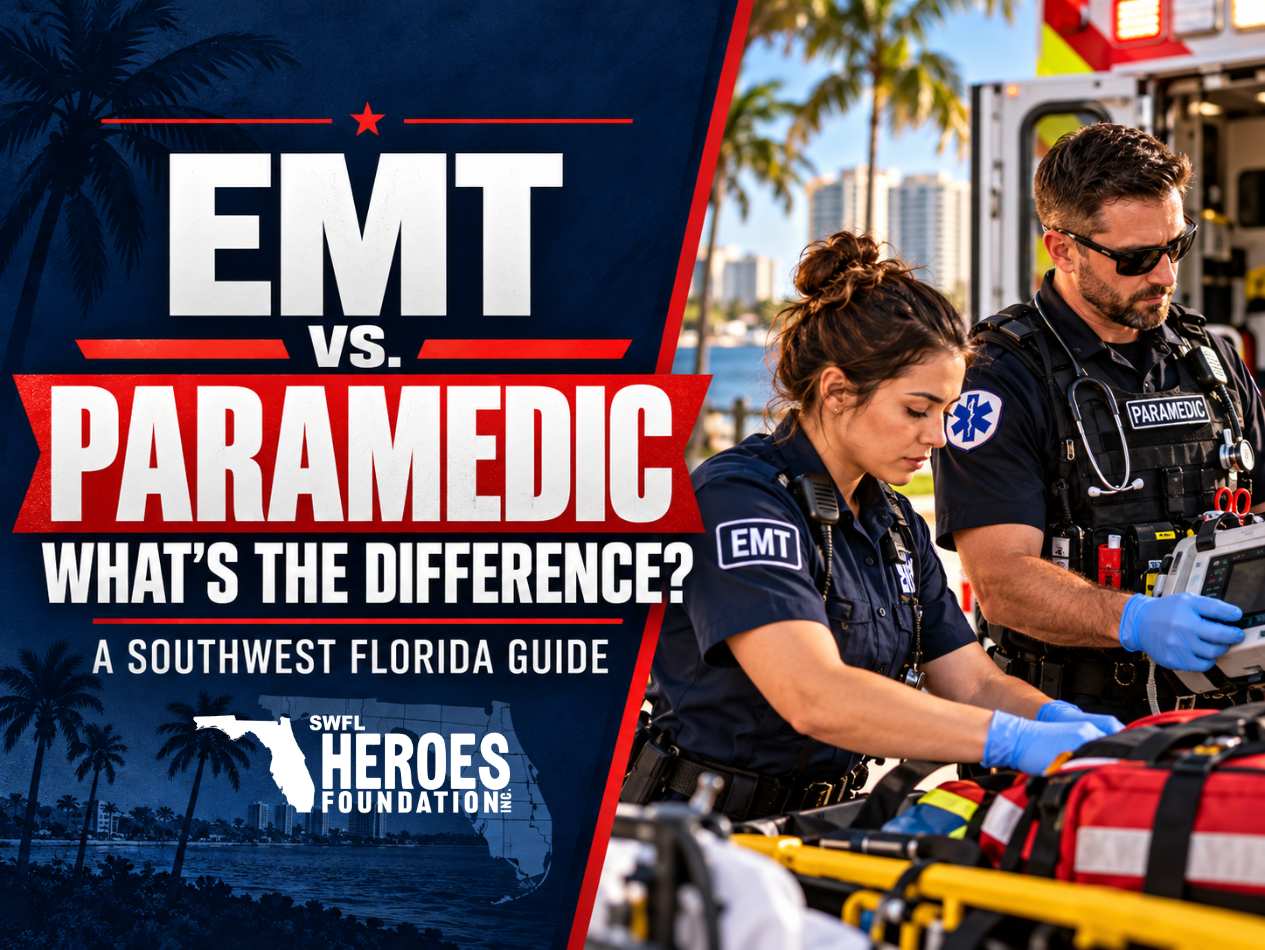
EMT vs. Paramedic: What's the Difference? A Southwest Florida Guide
When an ambulance or fire engine pulls up to an emergency, the people who jump out are usually EMTs, paramedics, or both. From the outside, they look like the same job. They’re not.
If you’re thinking about a career in emergency medicine or the fire service in Southwest Florida, understanding the difference between an EMT and a paramedic is one of the most important things you can know. It affects how long you’ll train, what you’ll pay for school, which jobs you can apply for, and how much you’ll earn.
The Short Answer
An EMT provides basic life support. A paramedic provides advanced life support.
EMTs stabilize patients and get them safely to the hospital. Paramedics can do much of that same work, plus more invasive, hospital-level care in the field, like starting IVs, giving medications, and reading heart rhythms.
There’s also an order to it: you have to become an EMT before you can become a paramedic.
What Does an EMT Do?
EMT vs Paramedic
EMTs are the foundation of emergency medical care. When they arrive on scene, they assess the patient’s condition, perform CPR or give oxygen when needed, control bleeding, and immobilize injured limbs.
Their focus is on keeping a patient stable and preventing further harm until the patient reaches the hospital. EMTs can give a limited number of medications, but EMTs cannot start an IV line or give shots, except for epinephrine.
What Does a Paramedic Do?
EMT vs Paramedic
EMTs are the foundation of emergency medical care. When they arrive on scene, they assess the patient’s condition, perform CPR or give oxygen when needed, control bleeding, and immobilize injured limbs.
Their focus is on keeping a patient stable and preventing further harm until the patient reaches the hospital. EMTs can give a limited number of medications, but EMTs cannot start an IV line or give shots, except for epinephrine.
| Category | EMT | Paramedic |
|---|---|---|
| Level of care | Basic life support | Advanced life support |
| IVs and injectable medications | No (except epinephrine) | Yes |
| Heart rhythm monitoring (ECG) | No | Yes |
| Advanced airways (intubation) | No | Yes |
| Training time | About 10 weeks to 1 semester | 1,100+ hours (about 13 to 15½ months) |
| Estimated cost (Florida resident) | About $3,500 to $4,000 | About $9,700 to $10,600 |
| Prerequisite | High school diploma, age 18 | Florida EMT certification |
Where to Get EMT and Paramedic Training in Southwest Florida
Southwest Florida students have several strong local options for EMT and paramedic training, and each school has its own strengths when it comes to schedules, format, and focus. Keep in mind that you must earn your EMT certification before you can start paramedic training, so many students complete both at the same school.
Southwest Florida Public Service Academy (Fort Myers)
The Southwest Florida Public Service Academy trains many of the region’s future firefighters and EMS professionals. It’s an extension of Fort Myers Technical College dedicated to preparing students for careers in public service, and it’s part of the Lee County School District.
- Offers both EMT and paramedic training, along with fire academy courses.
- The paramedic program meets every third day, excluding weekends, a schedule built around a firefighter’s shift.
- Learn more on the Southwest Florida Public Service Academy website.
Braxton College (Fort Myers)
Braxton College is a career-focused college in Fort Myers offering degrees and professional diplomas in Emergency Medical Services, Fire, and Nursing. It’s a popular choice for students who want flexible scheduling while they work.
- Offers both EMT and paramedic training, plus Firefighter I & II.
- Its paramedic program is accredited by CAAHEP, and it has offered a shift-friendly “C shift” paramedic class for working firefighters.
- EMT classes are offered during the day and at night, with night classes meeting Tuesdays and Wednesdays for lecture and Thursdays for lab, starting at 5 pm.
- Learn more on the Braxton College website.
Florida SouthWestern State College (FSW)
Florida SouthWestern State College offers EMT and paramedic training as college credit programs. That makes FSW a good fit for students who want their training to count toward a degree.
- Credits can apply toward an associate degree in Emergency Medical Services.
- Paramedic training includes clinical rotations in local hospital settings and internships with area EMS providers.
- Learn more on the FSW EMS programs page.
EMT vs Paramedic - How Long Does Training Take?
Training time depends on the school and the schedule you choose. EMT programs are relatively short, while paramedic programs are a much bigger commitment, often a year or more of classroom, clinical, and field training.
Southwest Florida Public Service Academy
The Academy’s EMT program is one of the fastest options in the area, and its paramedic program is designed around a working firefighter’s schedule.
- EMT: 300 hours, meeting Monday, Wednesday, and Thursday from 8:00 am to 5:00 pm plus field and clinical internships, which takes about ten weeks. The next class runs January 6, 2027 to March 17, 2027.
- Paramedic: 1,100 hours. The current class runs August 12, 2026 to September 9, 2027, so check with the Academy for the next start date.
Braxton College
Braxton’s programs run on a semester-style schedule, with day and night options for EMT students.
- EMT: About one semester.
- Paramedic: 1,136 hours.
Florida SouthWestern State College
FSW’s programs follow the college’s regular semester calendar, with EMT starting three times a year.
- EMT: One semester and 12 college credits, offered in the fall, spring, and summer semesters. Students must be 18 and have a high school diploma by completion.
- Paramedic: Four semesters (15½ months).
All told, going from zero to paramedic takes roughly a year and a half to two years, depending on the school.
EMT vs Paramedic - What Does It Cost?
Costs vary by school and by what each price includes, so it’s always smart to ask for a complete breakdown before you enroll. Here’s what local schools currently publish for Florida residents.
Southwest Florida Public Service Academy
The Academy publishes its course fees on its website and updates them regularly.
- EMT: $4,018.55 in-state.
- Paramedic: $10,580.12 in-state.
Braxton College
Braxton College doesn’t list tuition on its website, so contact the college directly for current pricing on both programs.
- EMT and Paramedic: Visit the Braxton College website or call the admissions office for current tuition.
Florida SouthWestern State College
FSW publishes detailed cost sheets that include tuition plus the extras, like books, lab fees, uniforms, and background screenings.
- EMT: $3,532.48 for Florida residents.
- Paramedic: $9,689.92 for Florida residents.
Add it up and the full path from EMT to paramedic costs more than $13,000 for a Florida resident, and that’s before fire academy.
Do Firefighters Need to Be EMTs or Paramedics?
In Florida, the answer is almost always yes. Firefighting and emergency medicine go hand in hand here, and nearly every career firefighter in Florida is also a paramedic or EMT, because fire departments here run medical calls, and medical calls make up a huge share of what firefighters respond to.
That’s why local job postings are titled “Firefighter/EMT” or “Firefighter/Paramedic.” It’s one person holding two certifications: fire academy training to fight fires, and EMT or paramedic training to treat patients.
That makes your medical certification a big factor in getting hired in Southwest Florida:
- Greater Naples Fire Rescue District requires EMT, and while a paramedic license isn’t required, it’s preferred.
- Cape Coral Fire Department’s current opening is for Firefighter/Paramedic, and EMTs may apply but must obtain paramedic within 5 years of date of hire.
- Lehigh Acres Fire Control and Rescue District lists current Florida State Paramedic Certification as a minimum requirement.
It affects your paycheck, too. At Greater Naples, a firefighter with EMT starts at $60,180, while a firefighter with paramedic starts at $70,190, thanks to a $10,010 paramedic incentive. At San Carlos Park Fire District, paramedic credentialing adds $3.90 an hour. For a closer look at what local departments pay, see our breakdown of [Firefighter Salary in Southwest Florida].
In other words, fire academy gets you in the door, but your medical certification decides which doors open, and how much you’ll earn once you’re through them.
Which Path Is Right for You?
Every paramedic starts as an EMT, so the first step is the same for everyone. From there, some students finish paramedic training before applying to fire departments, while many get hired as a Firefighter/EMT and earn their paramedic later, often through shift-friendly programs like those at the Southwest Florida Public Service Academy and Braxton College. The right path depends on your timeline, your budget, and what the departments you want to join require.
Training costs add up, and the SWFL Heroes Foundation awards a limited number of scholarships each year to help Southwest Florida students cover them.
Learn more on our Scholarship Application Page.
Join the mission through your gift of any amount.
We value the next generation of leaders by providing scholarships and educational support to our future community heroes.
Let’s do this together! Your gift of any amount is appreciated.