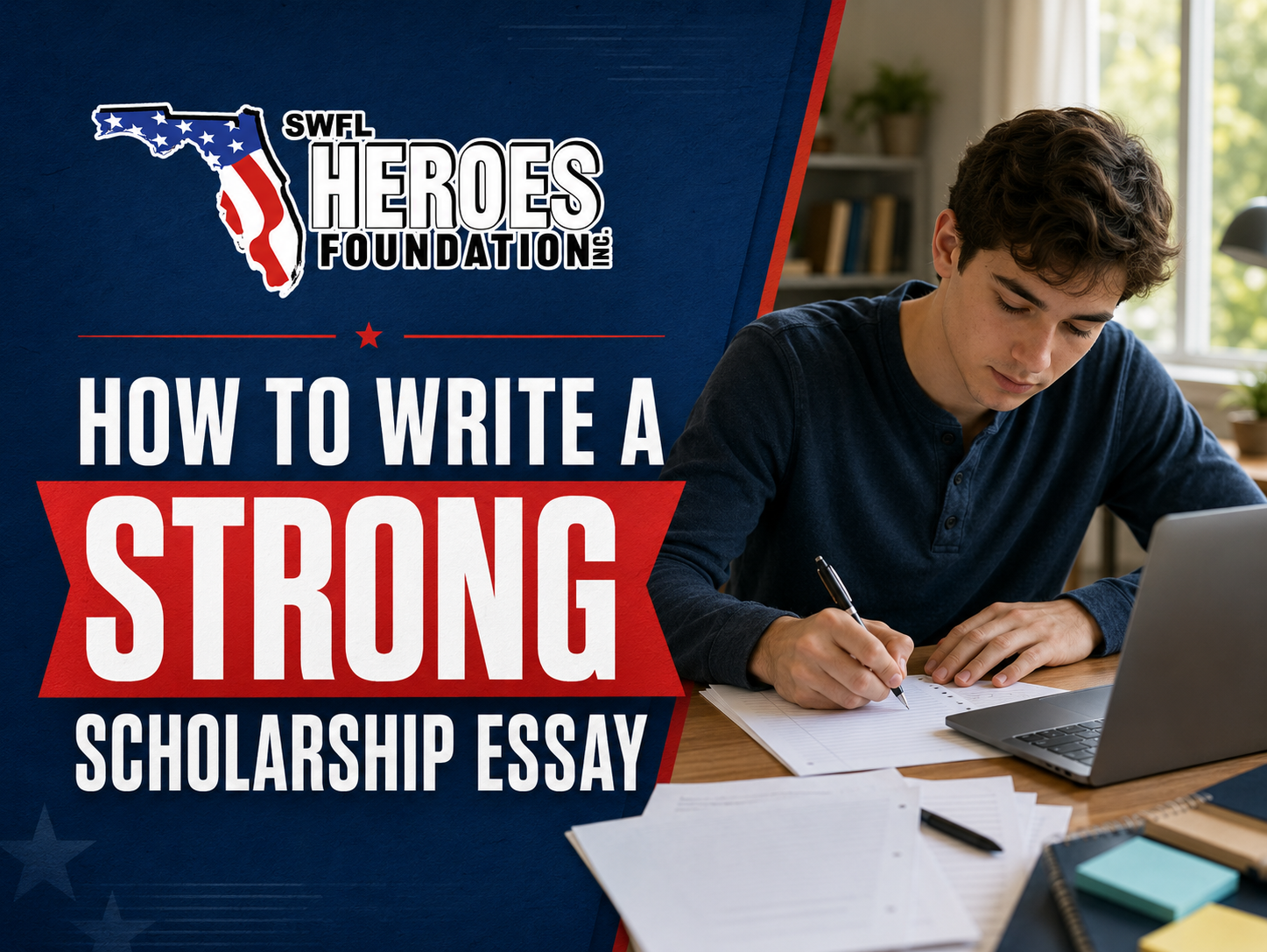
How to Write a Strong First Responder Scholarship Essay
Let’s talk about your scholarship essay. Applying for a first responder scholarship often means completing an application, providing references and submitting information about your education, community involvement and future plans. But how can you help your application stand out when many applicants may have similar qualifications?
One option is to include a well-written scholarship essay—even when an essay is not required.
The SWFL Heroes Foundation scholarship application includes a place to upload your résumé, but it does not require applicants to submit an essay. Not every applicant includes one. However, adding a thoughtful essay to the same PDF as your résumé gives the Scholarship Committee an opportunity to learn more about you, your goals and the experiences that led you toward a first responder career.
Will submitting an essay guarantee that you receive a scholarship? No.
Can a strong essay make your application more memorable? Absolutely.
Is a Scholarship Essay Required for the SWFL Heroes Foundation Scholarship?
No. An essay is not currently required to apply for a scholarship through the SWFL Heroes Foundation.
The application asks for information including:
- The school, academy or job course you plan to attend
- Whether you have been officially accepted
- Your class start date
- The amount requested
- The total cost of the program
- Additional costs for books or uniforms
- Academic honors and awards
- Extracurricular activities
- School-sponsored volunteer work
- Community volunteer activities
- References
- Your résumé
These questions give the Scholarship Committee important information about your eligibility, preparation and plans. An optional essay gives you space to connect those individual facts and explain the story behind them.
How Do You Submit an Optional Scholarship Essay?
The SWFL Heroes Foundation Scholarship Application Page includes an Upload Your Resume field.
If you want to submit an optional essay, create one PDF containing both your résumé and your essay. Your résumé can appear first, followed by the essay on the next page. Upload the combined document through the Upload Resume field.
Before uploading it, give the file a clear and professional name, such as:
Jordan-Smith-Resume-and-Scholarship-Essay.pdf
Open and check the completed PDF before submitting your application. Make sure every page is included, the text is readable and the document is not sideways, cut off or missing information.
What Should a First Responder Scholarship Essay Accomplish?
A strong essay should help the Scholarship Committee understand the person behind the application.
Your application already lists your school, program costs, activities and accomplishments. The scholarship essay should not simply repeat those answers in paragraph form. It should explain what influenced your decision, what you have done to prepare and why this opportunity matters to you.
The best scholarship essays are usually specific, honest and focused. You do not need to manufacture a dramatic story or make promises about the rest of your life. You only need to communicate clearly about the direction you are pursuing now and the effort you are prepared to make.
Begin With the Experience That Shaped Your Decision
Avoid beginning with a broad statement such as, “I have always wanted to help people.” Many applicants can truthfully say that, but it does not tell the committee much about you.
Instead, begin with a specific experience, realization or influence.
Perhaps you watched a first responder remain calm during an emergency. Maybe a family member introduced you to the profession. You may have participated in a public safety program, volunteered in your community or discovered that your abilities matched the demands of a particular field.
Explain what happened and why it stayed with you.
A specific opening gives your essay a personal foundation and makes it much more memorable than a collection of general statements.
Explain the Field You Are Pursuing
Clearly identify the school, academy, field of study or job course you plan to attend.
First responder careers can include firefighting, emergency medical services, law enforcement, corrections, criminal justice, dispatch and other public safety fields. Do not assume the Scholarship Committee will understand your exact plan from the name of the program alone.
Briefly explain:
- What program you plan to complete
- Why you selected it
- What you expect to learn
- How it connects to your current career goals
- What steps you have already taken toward enrollment or acceptance
You do not need to claim that you know exactly where you will be 20 years from now. It is enough to show that you understand your next step and are serious about completing it.
Show What You Have Already Done
Commitment is more convincing when it is supported by action.
Use part of your essay to explain how you have prepared for this opportunity. Depending on your background, that could include:
- Completing prerequisite courses
- Maintaining your academic performance
- Participating in volunteer activities
- Working while attending school
- Preparing physically for an academy
- Researching program requirements
- Earning related certifications
- Participating in an explorer or cadet program
- Saving money toward tuition, equipment or uniforms
- Learning from people already working in the field
Your actions do not need to be extraordinary. Consistent effort, responsibility and follow-through can say more about an applicant than an exaggerated claim.
Discuss Community Involvement Honestly
The application asks about both school-sponsored and non-school-sponsored volunteer activities.
Do not inflate your involvement or describe ordinary participation as though you managed an entire organization. Explain what you actually did, what responsibility you were given and what you learned from the experience.
If you have limited volunteer experience, be honest. You can still discuss employment, family responsibilities, school activities or other experiences that demonstrate maturity, reliability and the ability to work with others.
Specific examples are more persuasive than impressive-sounding but unsupported descriptions.
Explain Why the Scholarship Matters
The application already asks how much funding you are requesting and whether you need additional money for books or uniforms. Your essay can provide context without repeating every number.
Explain how the scholarship would help you move forward. It might reduce the amount you need to borrow, help pay for academy tuition or cover required books, uniforms or equipment. It may allow you to reduce work hours while completing a demanding program.
Be direct and factual. You do not need to exaggerate your financial circumstances. The goal is to help the committee understand what the scholarship would make possible.
End With Your Immediate Goals
Your conclusion should bring the essay back to the program and the next milestone you are working toward.
Explain what you plan to do after completing your education or training. Keep the conclusion realistic and connected to the information in the rest of your essay.
A strong ending could address:
- The program you intend to complete
- The qualification or certification you hope to earn
- The type of position you plan to pursue
- How you hope to contribute to your Southwest Florida community
- What receiving the scholarship would mean at this point in your education
Avoid ending with a generic statement such as, “Thank you for considering me.” It is perfectly appropriate to express gratitude, but first give the committee one final reason to remember your application.
A Simple Scholarship Essay Structure
You do not need to write an extremely long essay. Approximately 500 to 750 carefully written words may be enough to tell your story clearly.
A simple scholarship essay structure could include:
The Introduction
Describe the experience, person or realization that influenced your interest in a first responder career.
Your Current Plan
Identify the school or program you plan to attend and explain why you chose it.
Your Preparation
Discuss the academic work, employment, volunteering, training or other steps you have already completed.
Why the Scholarship Matters
Explain how the funding would help with tuition, books, uniforms, equipment or other necessary costs.
Your Next Goal
Describe what you plan to accomplish after completing the program and how you hope to use your training.
Mistakes to Avoid
Before submitting your essay, check for these common problems:
- Repeating the application without adding any personal context
- Using vague claims without examples
- Exaggerating experiences or accomplishments
- Writing what you think the committee wants to hear instead of being honest
- Submitting an essay written for a completely different scholarship
- Leaving another organization’s name in a reused essay
- Relying on artificial intelligence to invent your story or experiences
- Failing to proofread names, dates and program information
- Uploading an unfinished document
- Submitting a file the committee cannot open
Tools can help you check spelling, grammar and organization, but the experiences and goals in the essay must remain your own.
Review Your Combined PDF Before Submitting
Before uploading your résumé and essay, complete one final review:
- Confirm that your name and contact information are correct.
- Make sure your résumé is current.
- Verify the official name of your school or academy.
- Check that your essay matches the information entered in your application.
- Read the essay aloud to catch missing words or awkward sentences.
- Save the résumé and essay together as one PDF.
- Open the PDF and inspect every page.
- Use a professional filename.
Your essay does not need to sound as though it was written by a professional copywriter. It should sound like the clearest, most thoughtful version of you.
Applying for a SWFL Heroes Foundation Scholarship
At this time, applicants must be non-sponsored future first responders, current Southwest Florida residents and attending school in Southwest Florida.
An optional scholarship essay is not required, but it can help the Scholarship Committee better understand your preparation, your goals and what financial support would allow you to accomplish.
Complete every required application field carefully, upload your résumé and include your optional essay in the same PDF if you want to provide a fuller picture of your story.
Questions about the application can be sent to info@swflheroesfoundation.org.
Visit Our Scholarship Application Page
Join the mission through your gift of any amount.
We value the next generation of leaders by providing scholarships and educational support to our future community heroes.
Let’s do this together! Your gift of any amount is appreciated.